Games Jobs Index, meet Telegram

Every new games industry job, every morning, in one Telegram channel.

Games Jobs Index tracks over 16,000 live roles at more than 1,300 studios, read every morning straight from the studios’ own hiring systems.

The channel: t.me/GamesJobsIndex
One post a day with every role that appeared on the board that morning, across every studio and discipline. This morning that was 516 new roles from 168 studios. Follow it and you will not miss a posting.

Prefer alerts matched to you?
The bot: t.me/GamesJobsAlertsBot

Answer four questions: where, what kind of work, remote or on site, and your level, from entry to director. Every morning the bot checks the day’s new roles against your answers and sends one message with the matches. No match, no message.

Or run a search on gamesjobsindex.com, tap “Get alerts for this search”, and the bot fills in your filters from that search. You confirm with one tap.

Every role links to the studio’s own application page. Neither the channel nor the bot ever takes your application or sees it.

What the bot stores: your Telegram chat id and your filters. Nothing else. No account, no email, no tracking, and /stop deletes everything immediately.

If you know someone looking for their next games job, send them this.
The games jobs board has a new home: The Games Jobs Index

It started as a page on my personal site to help people find work after the 2022 layoffs. It has grown a fair bit since then, so today it moved out and got its own site, with a proper redesign to go with it!

What it does, and what it deliberately does not do:

  • 14,300 live jobs from 600+ studios hiring right now, read every morning at 07:00 UK directly from each studio’s own hiring system.
  • Every listing links straight to the studio’s own application page. No accounts, no application forms, no CV collection, and I take no cut of anything. Free means free, forever!
  • If a studio takes a job down, it is gone from the board the next morning. No ghost jobs.
  • Filter by discipline, country, remote and entry level, with a page for every country and every discipline.
  • 1,767 studios listed in total, including the ones whose systems I cannot read, so you still get a direct link to their careers page.

What else is new?

  • New Country and studio pages: easier access to finding studios in your area and seeing what other jobs a particular studio offers
  • Improved accessibility: light theme and screenreader improvements
  • Share functionality has improved and now works seamlessly on iOS devices and Android

I have also published how the whole thing works: how the counts are made and checked, exactly what I read from a studio’s hiring system and how to opt out of it, and what you can and cannot reuse from the board. That felt like the least I could do for a site that lists other people’s jobs.

gamesjobsindex.com

Old links still work. alexanderrehm.com/gamejobs and everything under it now redirects, so any bookmark or post you have saved will land in the right place.

If you spot something broken, or a studio I am missing, please comment or message me.

More to come.

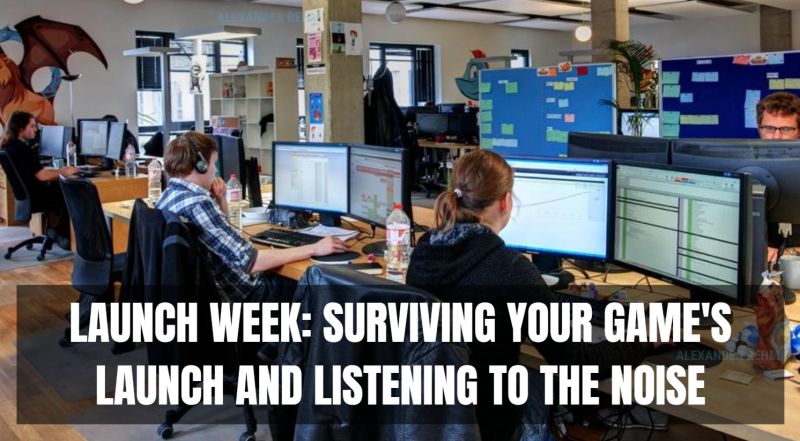
Congratulations, you’ve launched your first live game! Now the real work begins.

The transition from “Development” to “LiveOps” can be violent. You are moving from a world of assumptions to a world of hard truths.

Usually what happens is that your first 48h are pure chaos, fighting fires, fixing P0’s and getting the game stable. And then, the first month is a chaotic firehose of data, bugs, and player sentiment. The studios that win aren’t the ones with the perfect launch; they are the ones with the best reaction to an imperfect one.

Here is what you need to watch out for and how to operationalize that early feedback:
The FTUE cliff locations: Don’t just look at D1 Retention. Look at the specific step where players quit. If 20% of users drop off at “Mission 3,” you don’t have a retention problem; you have a difficulty spike or a UI bug.
Fix this immediately.

Triangulate sentiment vs. behavior: Players will scream that “progression is too slow.” Before you buff rewards, look at the data. Are they actually quitting? Or are they grinding happily while complaining?
Fix the “feel,” but trust the action.

The Economy faucet check: Watch your currency inflows vs. outflows like a hawk. If players are hoarding currency (not spending), your sinks are unappealing. If they are broke (starved), your pacing is too harsh.
Early economy exploits must be patched in hours, not days.

Identify the outliers: Set up automated alerts for statistical anomalies. If one player earns 10x the average gold in an hour, they haven’t “played well”—they’ve found a dupe or an exploit.
Catching this early saves you from a database rollback.

The meta velocity: Players will solve your game 100x faster than you expected. Watch the “Time to Cap” for your content.
If players are consuming a month’s worth of content in 3 days, you need to accelerate your “Evergreen” systems or activate a “slow-down” event immediately.

Technical friction logs: A player saying “it’s laggy” is noise. Look at your server-side logs for “failed handshakes,” “high latency spikes,” or “matchmaking timeouts.”
These invisible technical frustrations kill retention faster than bad game design.

Be ready to tear down your roadmap: The roadmap you wrote pre-launch is now a hypothesis. If players love a feature you thought was minor, pivot your team to support it. If they hate your “headline feature,” cut your losses.
The LiveOps roadmap must be fluid.

The launch window is a test of your team’s agility.
Listen to the data, respect the player’s time, and be willing to change everything you thought you knew.

Lessons Learned: PlayStation’s Live Service Ambitions Move Forward with Bungie’s Marathon

Interesting insights from PlayStation Studios boss Hermen Hulst regarding Sony’s live service strategy. During a recent fireside chat for investors, Hulst emphasized that the live service market remains a “great opportunity” for PlayStation, acknowledging their “patchy track record” but asserting a clear path forward.

Last year saw challenges, including the swift launch and subsequent shuttering of the hero shooter Concord, followed by the closure of developer Firewalk. Earlier this year, two more live service titles were scrapped from Bluepoint Games and Bend Studio, with recent layoffs confirmed at Bend as they transition to a new project.

However, Hulst insists that PlayStation has learned hard lessons from these experiences. Speaking specifically about Bungie’s upcoming live service shooter, Marathon, he expressed confidence in its potential for success.

Keep Reading

26 Essential books for Game Design, Development, Business and Leadership

Here are some of my favourite books, all about Game Dev:

Game Design:

Development:

Game Leadership:

LiveOps:

Business:

Community:

Scopely to acquire Niantic, Inc.’s Games Business, including Pokémon GO, for $3.5 Billion

Scopely, the developer behind MONOPOLY GO! and Stumble Guys, has announced its acquisition of Niantic’s games business for $3.5 billion, plus an additional $350 million cash distribution from Niantic. This deal includes popular titles like Pokémon GO, Pikmin Bloom, and Monster Hunter Now, along with their respective development teams.

Niantic cites Scopely’s expertise in live services, working with major IPs, and community focus as key factors in the acquisition. They assure players that the games will continue to receive long-term support and investment from Scopely, driven by the existing development teams.

Detailed information about the acquisition can be found on the Scopely blog, including messages from Scopely’s co-CEOs and the Pokémon GO team lead.

Simultaneously, Niantic will spin off its geospatial AI business into a new company, Niantic Spatial, led by John Hanke. This new venture will be funded with $250 million, including $200 million from Niantic’s existing funds and a $50 million investment from Scopely.

Source: https://www.scopely.com/en/news/scopely-to-acquire-niantic-games-business-which-includes-pokemon-go-one-of-the-most-successful-mobile-games-of-all-time